

Bridging practice and precision for early-stage resectable NSCLC: Malaysia’s first surgical consensus
22 Oct 2025
Share
Lung cancer is the leading cause of cancer-related mortality worldwide, with approximately 2.5 million new cases diagnosed annually.1 In Malaysia, it is the second most common cancer among men and third among women, accounting for nearly 10% of all malignancies.1 Non-small cell lung cancer (NSCLC) represents 85% of cases, of which about one-quarter are diagnosed at early stages.1 However, outcomes remain poor, with national registry data showing 5-year relative survival rates of only 37.1% for stage I and 17.4% for stage II disease.1 These findings underscore the urgent need for standardized and comprehensive perioperative management strategies in early-stage resectable NSCLC.1
Previously, no national clinical practice guidelines existed for surgical care in Malaysian patients with early-stage NSCLC, leading to variability in screening, diagnosis, treatment, and surveillance.1 To bridge this gap, a panel of nine high-volume thoracic surgeons representing public, private, and academic institutions across Malaysia convened to develop consensus recommendations tailored to local healthcare realities.1 The experts met in three rounds, reviewing international trial evidence alongside Malaysian practice data.1 A modified Delphi method was applied to draft and refine recommendations, with consensus defined as ≥75% agreement.1 Ultimately, unanimous agreement (100%) was achieved across all domains.1 The draft was externally reviewed by senior oncologists and respiratory physicians before finalization.1
The consensus outlines best practices across five domains: screening, diagnosis and staging, neoadjuvant/perioperative therapy, adjuvant therapy, and operative procedures with surveillance.1 Key highlights include early referral to a lung specialist within two weeks of presentation, definitive treatment within 4-6 weeks of consultation, reflex molecular testing (EGFR, ALK, PD-L1) at diagnosis, and multidisciplinary tumor board discussions.1 The recommendations also emphasize the integration of biomarker-driven targeted and immunotherapies in both neoadjuvant and perioperative settings, along with the importance of mediastinal lymph node clearance and stage-dependent surveillance.1 The following listed the consensus recommendations (table 1).1
| Screening | |
| 1 | Screening should be offered to individuals aged 45 to 75 years with a tobacco smoking history of ≥20 years, including current or former smokers |
| 2 | Screening is recommended in high-risk non-smokers (age >40 years) with a significant family history (e.g., first-degree relative) of lung cancer |
| 3 | LDCT thoracic imaging is the gold standard for lung cancer screening |
| Diagnosis and staging | |
| 4 | Any patient with suspected lung cancer should be seen by a relevant lung specialist (respiratory physician, cardiothoracic/thoracic surgeon, oncologist) within 2 weeks from the initial presentation |
| 5 | Patients with early-stage resectable NSCLC should commence definitive treatment (e.g., surgery/neoadjuvant therapy) within 4 to 6 weeks of initial specialist consultation |
| 6 | At the time of initial histological diagnosis, minimum genomic molecular profiling (EGFR, ALK, PD-L1 expression) should be performed as a reflex testing, where feasible for stage IIA–IIIB-N2 NSCLC |
| 7 | The mandatory staging modalities should include CE-CT of the thorax and whole-body PET-CT. If PET-CT is not available, a CE-CT of the abdomen and pelvis should then be performed |
| 8 | CE-MRI of the brain is recommended for stage II and above, or where clinically indicated. If brain MRI is not feasible, CE-CT of the brain is acceptable |
| 9 | Pathologic (cytohistological) confirmation of clinical N2 disease should be routinely performed prior to definitive therapy |
| Neoadjuvant and perioperative treatment | |
| 10 | All potentially resectable stage III NSCLC should be discussed in a multidisciplinary setting for consideration for neoadjuvant treatment |
| 11 | For resectable stage II NSCLC, upfront resection is a reasonable strategy in many instances, unless there is a concern with the ability to achieve complete resection with a lobectomy |
| 12 | Radiotherapy should not be recommended as part of pre-operative treatment for resectable NSCLC |
| Adjuvant treatment | |
| 13 | All patients with fully resected stage IB to IIIB (≤N2) NSCLC should receive an oncology† consultation (within 4 weeks) to discuss adjuvant therapy options based on tumour genomic profiling from the initial biopsy or resected specimen for actionable driver alterations (EGFR and ALK) and PD-L1 expression |
| 14 | All patients with fully resected (stage IB to IIIB) EGFR-mutant NSCLC (Del 19/L858) should be offered osimertinib 80 mg once daily +/− chemotherapy for at least 3 years, based on DFS/OS benefit from ADAURA‡ study |
| 15 | All patients with fully resected (stage IB to IIIB) ALK-fusion positive NSCLC should be offered alectinib 600 mg twice daily +/− chemotherapy for at least 2 years, based on DFS/CNS-DFS benefit from ALINA‡ study |
| 16 | Adjuvant immunotherapy with chemotherapy should be considered in resected stage IB to IIIB patients with PD-L1 ≥1% and no EGFR or ALK alterations but is not routinely recommended for those with PD-L1 <1% |
| Operative procedures and post-resection surveillance | |
| 17 | With R0 resection in mind, a minimally invasive approach is favoured for its lower post-operative morbidity and oncological non-inferiority to thoracotomy. However, its adoption depends on the surgeon’s experience |
| 18 | Lobectomy remains the standard of care for medically fit patients with early-stage NSCLC |
| 19 | Sublobar resection may be an option in (I) patients with a smaller peripheral tumour <2 cm, with proven lymph node-negative (N0), and/or (II) medically unfit patients (e.g., with limited lung function or significant comorbidities). Patients should be informed that a sublobar resection might be associated with a higher risk of locoregional recurrence |
| 20 | Curative resection includes adequate intraoperative mediastinal lymph node sampling or clearance of three mediastinal (N2) and one hilar (N1) station(s) |
| 21 | Post-operative surveillance should be stage-dependent and conducted for a minimum of 5 years by a dedicated lung specialist (e.g., respiratory physician, cardiothoracic/thoracic surgeon, oncologist), using CT/PET-CT scan (stage I to II every 6 months for 3 years then annually for another 2 years, stage III every 3 to 6 months for 3 to 5 years, or as clinically indicated) |
Table 1. Surgical consensus recommendations for early-stage resectable NSCLC
†Some respiratory physicians in Malaysia treat lung cancer; hence, the term “oncology consultation” encompasses consultations with oncologists or treating respiratory physicians; ‡Both the ADAURA and ALINA studies recruited patients with stage IB–IIIA NSCLC (AJCC-UICC 7th edn.)
AJCC-UICC: American Joint Committee on Cancer-Union for International Cancer Control; ALK: Anaplastic lymphoma kinase; CE: Contrast enhanced; CNS: Central nervous system; CT: Computed tomography; DFS: Disease-free survival; EGFR: Epidermal growth factor receptor; LDCT: Low-dose computed tomography; MRI: Magnetic resonance imaging; NSCLC: Non-small cell lung cancer; OS: Overall survival; PD-L1: Programmed death-ligand 1; PET: Positron emission tomography
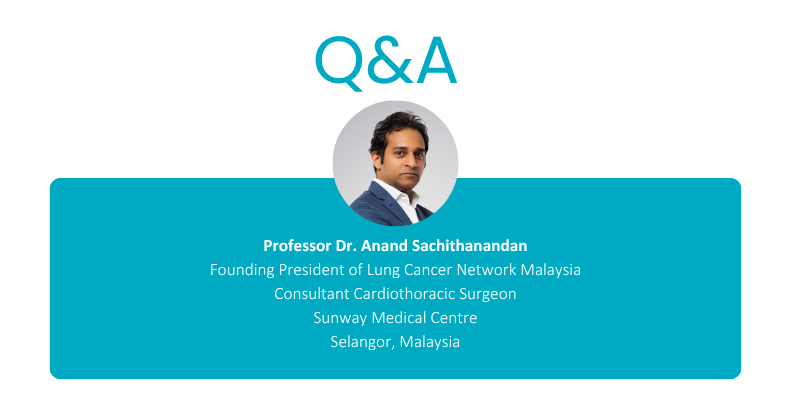
In an interview with Omnihealth Practice, Prof. Dr. Anand Sachithanandan discussed the key gaps in lung cancer management and the nationwide efforts to advance early detection, timely treatment, and equitable surgical care.
Q1. What were the main gaps in lung cancer management that prompted the need for a surgical consensus in Malaysia?
Prof. Dr. Anand: Lung cancer remains one of the most common and deadliest cancers in Malaysia, with mortality rates staying high despite advances in treatment. About 80%-85% of cases are NSCLC, yet we still don’t have a dedicated local guideline for its management. With our high smoking rates and diverse patient population, there’s a real need for recommendations that reflect Malaysia’s healthcare realities. The new surgical consensus aims to elevate and harmonize standards of care across the country, ensuring equitable access to evidence-based surgical management, even beyond major urban centers.
Q2. What are the underlying reasons for poor prognosis in lung cancer, and what measures are needed to enhance early detection and achieve a stage shift locally?
Prof. Dr. Anand: The main issue is late diagnosis; most patients present at stage III or IV, when curative options are limited. This stems from low screening uptake and lack of awareness. We need stronger public education, risk-based screening, and greater engagement of primary care. The consensus recommends screening for individuals with known risk factors, and all smokers should be supported to quit through sustained education. Primary care providers play a vital role; they need to recognize red flags, keep a low threshold for screening, and refer high-risk individuals promptly for imaging or specialist review. These steps can help us detect cases earlier and shift diagnoses to more treatable stages.
Q3. What are the main barriers to implementing the new surgical consensus, and how can they be overcome?
Prof. Dr. Anand: The biggest challenges are treatment delays and uneven access to diagnostic facilities. We’ve set clear benchmarks to help clinicians manage cases within recommended timelines, which can significantly shorten the time to treatment. Access to advanced diagnostics like PET-CT, EBUS, and molecular testing is still inconsistent, but these are crucial—especially molecular testing, which identifies actionable mutations for targeted therapy. Adopting reflex molecular testing can streamline workflows and speed up treatment planning. We also need stronger public–private collaboration, better funding, and reduced testing costs to ensure equitable access. Ultimately, a strong multidisciplinary team approach remains key to delivering optimal multimodal treatment and achieving the goals of this new consensus.
References
- Sachithanandan A, et al. Surgical consensus for screening, diagnosis, staging, multimodal management and surveillance of early-stage resectable non-small cell lung cancer (NSCLC) in Malaysia. Transl Lung Cancer Res. 2025;14(7):2403-2426.