Twice-yearly depemokimab sustains 2-year response in uncontrolled asthma: SWIFT/AGILE responder analysis
11 Nov 2026
Share
STUDY DESIGN
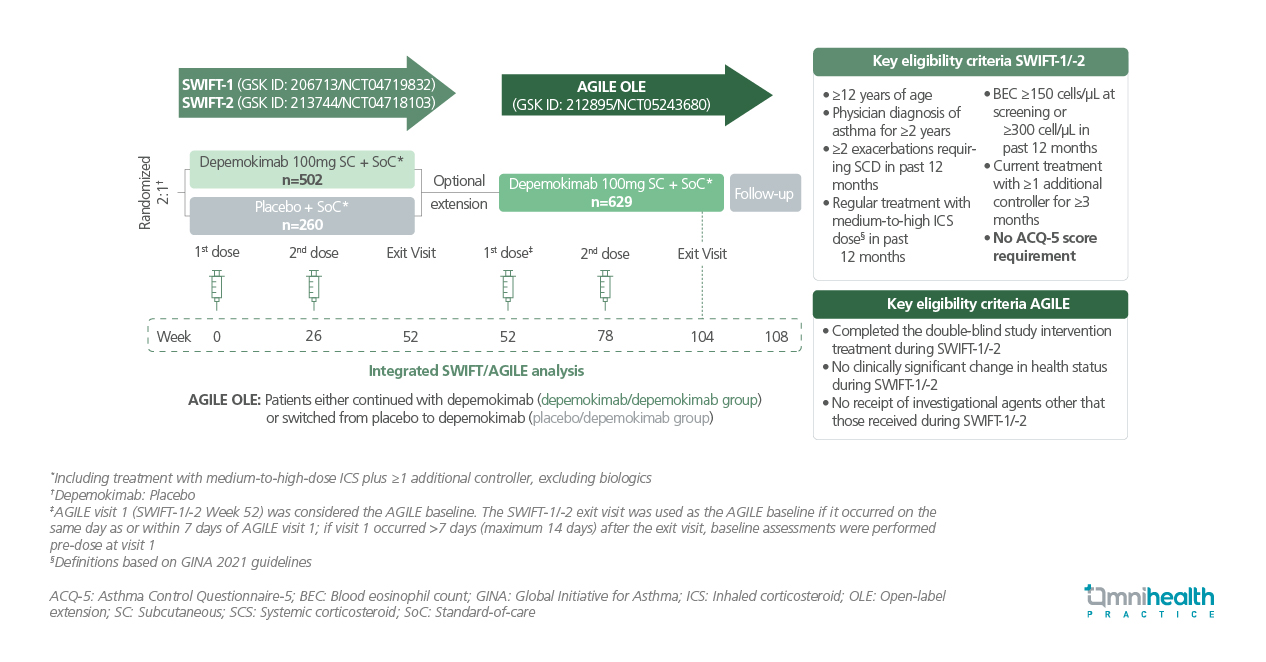
Depemokimab is the first ultra-long-acting biologic targeting interleukin-5 (IL-5), with enhanced IL-5 binding affinity and potency and an extended half-life conferred by a modified YTE fragment crystallizable (Fc) region, enabling twice-yearly administration and sustained suppression of type 2 inflammation.1 In the phase 3 SWIFT-1/-2 studies, depemokimab reduced exacerbations by 54% vs. placebo over 52 weeks in patients with type 2 asthma.1 Its long-term efficacy and safety were subsequently evaluated in the single-arm AGILE open-label extension (OLE) study.1
The SWIFT/AGILE integrated analysis included patients from the replicate, randomized, double-blind, placebo-controlled SWIFT-1/-2 studies and the subsequent single-arm AGILE OLE.1 In SWIFT-1/-2, patients were randomized 2:1 to depemokimab 100mg subcutaneously (SC) + standard-of-care (SOC) or placebo + SOC, then continued or switched to depemokimab in AGILE.1 Of the 762 patients included in the analysis, 641 entered AGILE and 629 received ≥1 depemokimab dose and were included in the integrated analyses.1
A post hoc responder analysis was conducted to evaluate the 559 patients (73%) with uncontrolled symptoms at baseline (ACQ-5 ≥1.5) who achieved a clinical response to depemokimab in SWIFT-1/-2 and AGILE.1 Baseline characteristics were broadly similar between patients with and without uncontrolled symptoms, including blood eosinophil counts and exacerbation history.1
Clinical response was assessed using three individual endpoints and a composite endpoint: a ≥50% reduction in exacerbations, ≥4-point reduction in St. George’s Respiratory Questionnaire (SGRQ) total score, or ≥0.5-point reduction in ACQ-5 score.1 The composite endpoint is considered achieved when all three individual endpoints are met.1
FINDINGS
| Individual endpoints: |
|
| Composite endpoint: |
|
“Twice-yearly depemokimab provided sustained, clinically meaningful composite responses over 2 years in a high proportion of patients with uncontrolled asthma symptoms at baseline, supporting its role in asthma management”
Presented by:
Professor Ian D. Pavord
Oxford Respiratory NIHR BRC,
Nuffield Department of Clinical Medicine,
University of Oxford,
United Kingdom
References
- Pavord ID, et al. Twice-yearly depemokimab maintains clinically meaningful response over 2 years in patients with uncontrolled asthma symptoms at baseline: Responder analysis of the integrated SWIFT/AGILE studies. Presented at the European Respiratory Society (ERS) Congress 2026; September 5-9, 2026