

Refining risk stratification and treatment in dyslipidemia: The 2025 ESC/EAS focused update
11 Sep 2025
Share
Since the publication of the 2019 European Society of Cardiology (ESC)/European Atherosclerosis Society (EAS) Guidelines on the management of dyslipidemias, several randomized controlled trials have provided new evidence that may influence patient management ahead of the next comprehensive guideline update. Drawing on findings from major outcome trials including CLEAR Outcomes (bempedoic acid), ELIPSE HoFH (evinacumab), REPRIEVE (statins in human immunodeficiency virus [HIV] infection), STRENGTH (omega-3 carboxylic acids), REDUCE- IT (icosapent ethyl), SPORT (dietary supplements), and OMEMI (omega-3 in the elderly), the 2025 Focused Update introduced new and revised recommendations, ensuring that clinical practice reflects the most current evidence base and supports individualized CV risk management.1
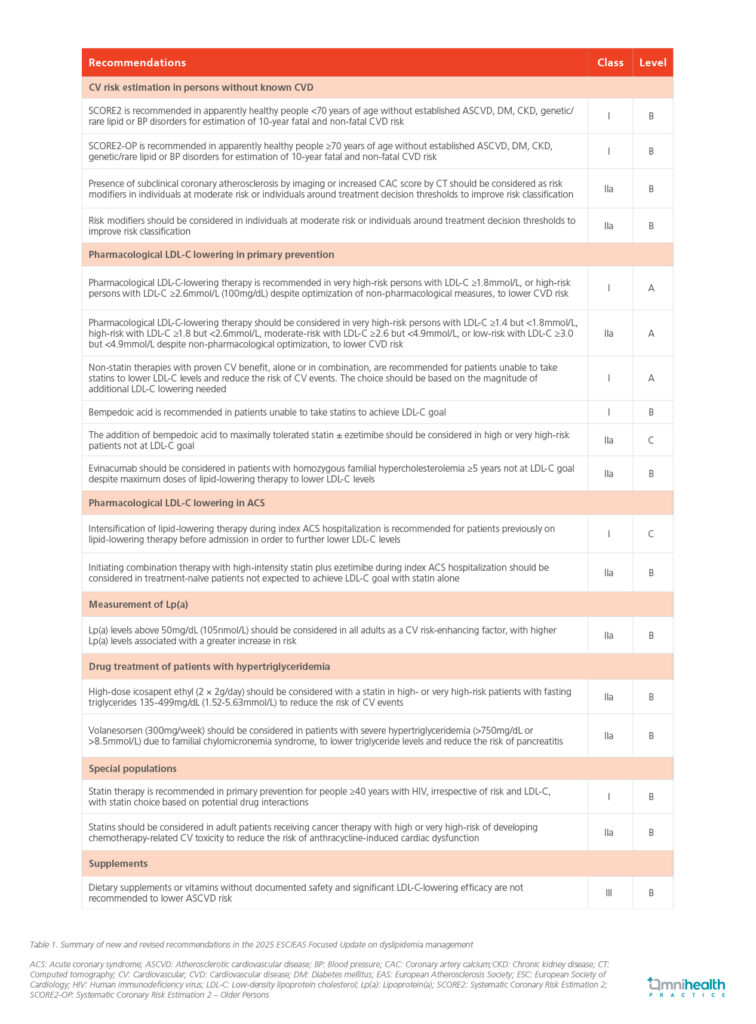
The focused update specified changes to recommendations in several key areas (table 1).1 First, CV risk estimation has been refined through the use of SCORE2 and SCORE2-OP, with additional risk modifiers such as subclinical coronary atherosclerosis and increased coronary ar tery calcium (CAC) scores to enhance risk classification.1 Broader LDL-C treatment thresholds have also been defined, incorporating bempedoic acid and evinacumab as new therapeutic options.1
Furthermore, it is recommended that lipid-lowering therapy be intensified during acute coronary syndrome hospitalization, including the early initiation of combination therapy.1 Lipoprotein(a) has been identified as a CV risk enhancer, with elevated levels correlating with increased cardiovascular risk.1 Measurement of lipoprotein(a) at least once in a lifetime is particularly advised for individuals with premature cardiovascular disease, a family history of atherosclerotic cardiovascular disease (ASCVD), familial hypercholesterolemia, or those who are post menopausal.1 Additionally, targeted triglyceride-lowering strategies are supported, including the use of icosapent ethyl and volanesorsen.1 The use of statins for primary prevention has been expanded to include people with HIV and cancer patients at risk of chemotherapy-related cardiotoxicity.1 Lastly, a class III recommendation has been established against the use of dietary supplements that lack proven efficacy.1
In summary, the 2025 ESC/EAS Focused Update provides additive and revised recommendations to the 2019 guidelines, reflecting the latest evidence from randomized controlled trials and meta analyses.1 By updating CV risk assessment methods and incorporating new therapeutic strategies, the update aims to strengthen clinical decision-making, improve precision of therapy and enhance ASCVD prevention.1
References
- Mach F, et al. 2025 Focused Update of the 2019 ESC/EAS guidelines for the management of dyslipidaemias. Presented at European Society of Cardiology (ESC) Congress 2025; August 29-September 1, 2025.